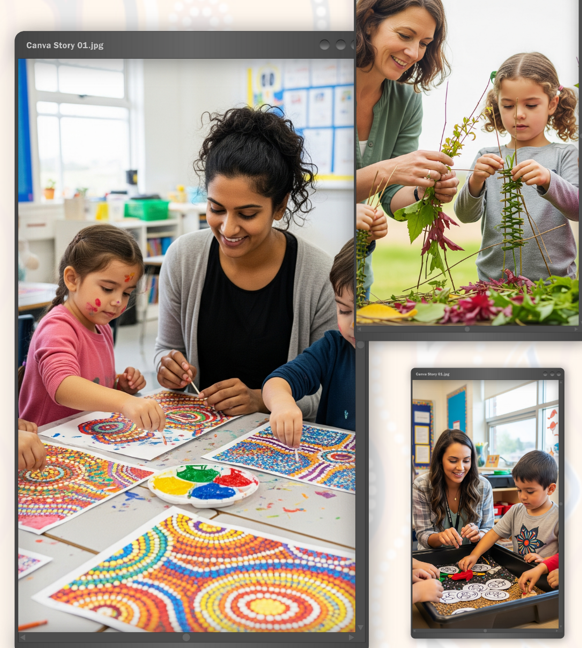
Integrating NAIDOC Week into your teaching is a fantastic way to foster cultural awareness, respect, and understanding from a young age. This series, designed with the help of Early Edu AI, offers practical, hands-on activities that align with the EYLF and engage children in meaningful learning.
1. Weaving with Natural Materials
This activity connects children to traditional Indigenous craft techniques, developing patience and fine motor skills.
What you'll need:
- Small weaving looms or sturdy cardboard frames
- Dried grasses, flexible raffia
- Yarn in earthy or natural colours
Instructions:
Demonstrate simple weaving techniques, showing children how to move the materials over and under the frame. Children can then create their own small woven pieces, like a mat or a unique piece of art. The process of threading and wrapping develops hand-eye coordination and introduces them to the beauty and wisdom of traditional crafts.
Learning Outcomes (EYLF):
This activity supports Outcome 4 (Confident and Involved Learners) by developing fine motor skills and persistence, and Outcome 2 (Connected with and Contribute to their World) by exploring community and cultural traditions.
2. Indigenous Symbols Sensory Bin
A classic and beloved activity that introduces children to the rich visual language of Indigenous cultures in a playful, tactile way.
What you'll need:
- A large sensory bin filled with clean sand
- Smooth stones, dry leaves, and small wooden discs
- Wooden discs pre-marked with common Indigenous symbols (e.g., kangaroo tracks, concentric circles for waterholes, meeting place symbols)
Instructions:
Invite children to explore the sensory bin with their hands, feeling the different textures. As they discover the symbols, you can discuss their meanings in a simple, conversational way. This hands-on exploration builds a foundational respect for Indigenous culture in a relaxed and engaging atmosphere.
Learning Outcomes (EYLF):
This activity promotes Outcome 1 (Strong Sense of Identity) by fostering an understanding of diverse cultures and Outcome 5 (Effective Communicators) by introducing symbolic languages.
3. Making a Didgeridoo
This craft activity sparks creativity and allows children to create their own version of a famous Indigenous instrument.
What you'll need:
- Cardboard tubes
- Paints in various colours
- Cotton buds for dot painting
Instructions:
Let each child decorate their own cardboard tube "didgeridoo" using dot painting techniques with cotton buds. While the creations will be simple, they represent the child's own artistic expression. Children will love pretending to play their instruments, engaging in imaginative play.
Learning Outcomes (EYLF):
This activity enhances Outcome 4 by encouraging creativity and imagination, and Outcome 2 by engaging with cultural practices and artifacts.
4. "Finding Our Heart" Craft
Based on the book explaining the Uluru Statement from the Heart, this activity teaches children about listening, respect, and reconciliation.
What you'll need:
- The book "Finding Our Heart"
- Coloured paper hearts
- Markers, crayons, and glitter
- String or yarn
Instructions:
Read the book together, simplifying abstract concepts to help children understand that everyone's voice is important and deserves to be heard. Afterwards, children can decorate a paper heart, drawing what is important to them. String these hearts together to create a garland for the classroom, symbolizing unity and respect.
Learning Outcomes (EYLF):
This activity deeply supports Outcome 1 by helping children express their identity and understand the feelings of others, and Outcome 2 by introducing concepts of community, fairness, and reconciliation.
Back to all resources